 CONTACT





- ERNs
- Patient Stories
- THIJS'S STORY
THIJS’S STORY

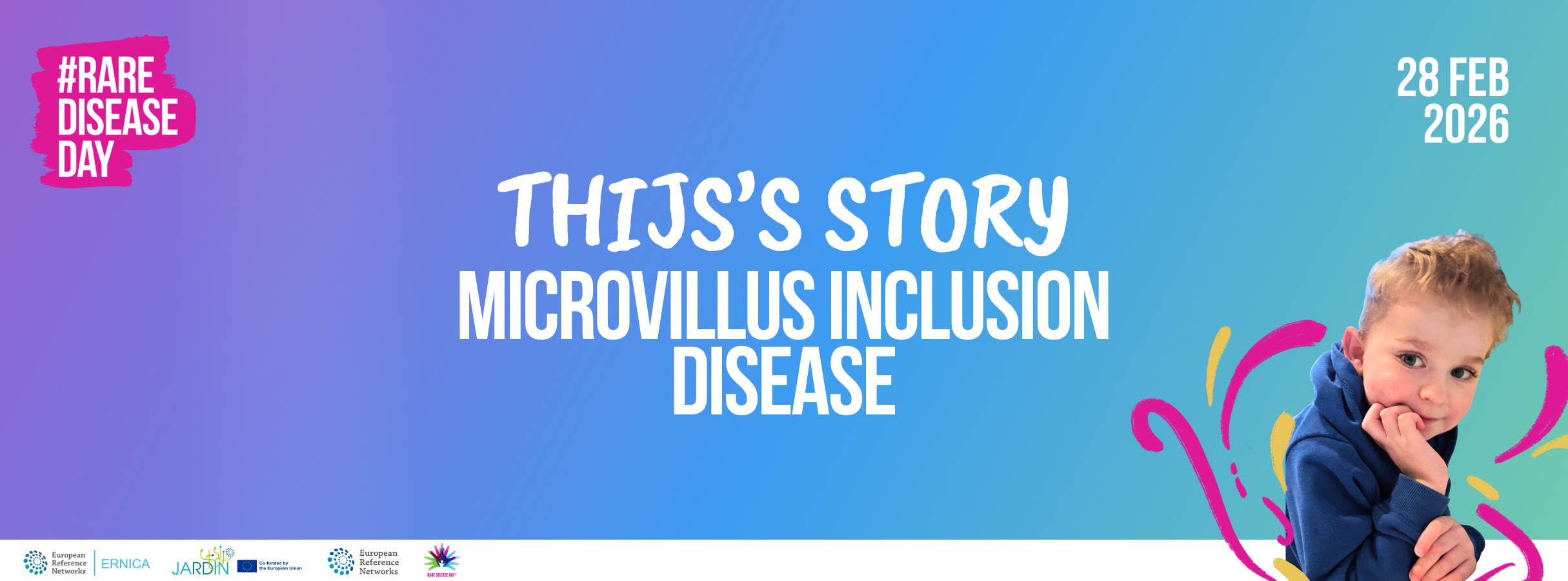
Thijs has never taken a bite of food in his life. He does not know what it feels like to enjoy an ice cream in the summer, or to have fries on a terrace after swimming. Most people cannot imagine what it is like not to eat or drink; for Thijs, this is his everyday reality.
Thijs was born with the genetic condition Microvillus Inclusion Disease, a very rare disorder of the small intestine. A gene mutation in the MYO5B gene prevents metabolism from taking place in the small intestine, meaning that children with this condition cannot survive on food and drink. They are completely dependent on intravenous nutrition, also known as total parenteral nutrition (TPN). Thijs could eat, but his body is unable to absorb any nutrients from food.
Thijs is a cheerful and curious four-year-old boy. He talks nonstop and enjoys going to school. In the morning, there does not seem to be much wrong. He is small for his age and has some additional motor challenges, but he is able to participate well in class. However, after a few hours at school in the morning, his energy is depleted. He becomes nauseous and very tired. Then it is time for his daily medicines and feeding.
Every 24 hours, Thijs receives medication and nutrition for 16 hours through a central line in his chest. This means that during this time his freedom of movement is limited, and medical supervision is necessary. If he develops a fever, there is an immediate risk of a line infection, which can lead to sepsis. In such cases, it is essential that he is checked at the hospital right away. There is also always a risk of serious blood imbalances. If he does not feel well or stops growing for a longer period, there is a high chance that the composition of his nutrition needs to be adjusted.
He faces many hospital visits, stays, and operations because of his line. At home, too, he experiences the daily consequences of his condition. His parents are not only his mother and father, but also his nurses. He cannot always keep up with his older brother and has less energy. Staying overnight with his grandparents is not possible. And what do you do when the rest of the family sits down to eat together? Still, thanks to his treatment, Thijs is able to grow, learn, and enjoy life.
In the Netherlands, there are six children living with Microvillus Inclusion Disease. Worldwide, it is estimated that around 200 people live with this condition. Thanks to better medical care, more children with this condition are surviving and growing older. For Thijs, this means a future in which there is hope that further research will lead to greater knowledge of the disease and possibly a treatment. ERNICA plays an important role in this. International knowledge sharing among professionals is crucial when the patient population is so small. ERNICA can also play a major role in improving quality of life. Children receiving TPN at home and their families face significant challenges. By staying connected and sharing successes as well as important lessons, patients and their families, and healthcare professionals, can all benefit.


