 CONTACT





- ERNs
- Patient Stories
- OLGA’S STORY
OLGA’S STORY
- February 16th, 2026
- ERN ReCONNET. ERN on connective tissue and musculoskeletal diseases
-
 Czech Republic
- Share
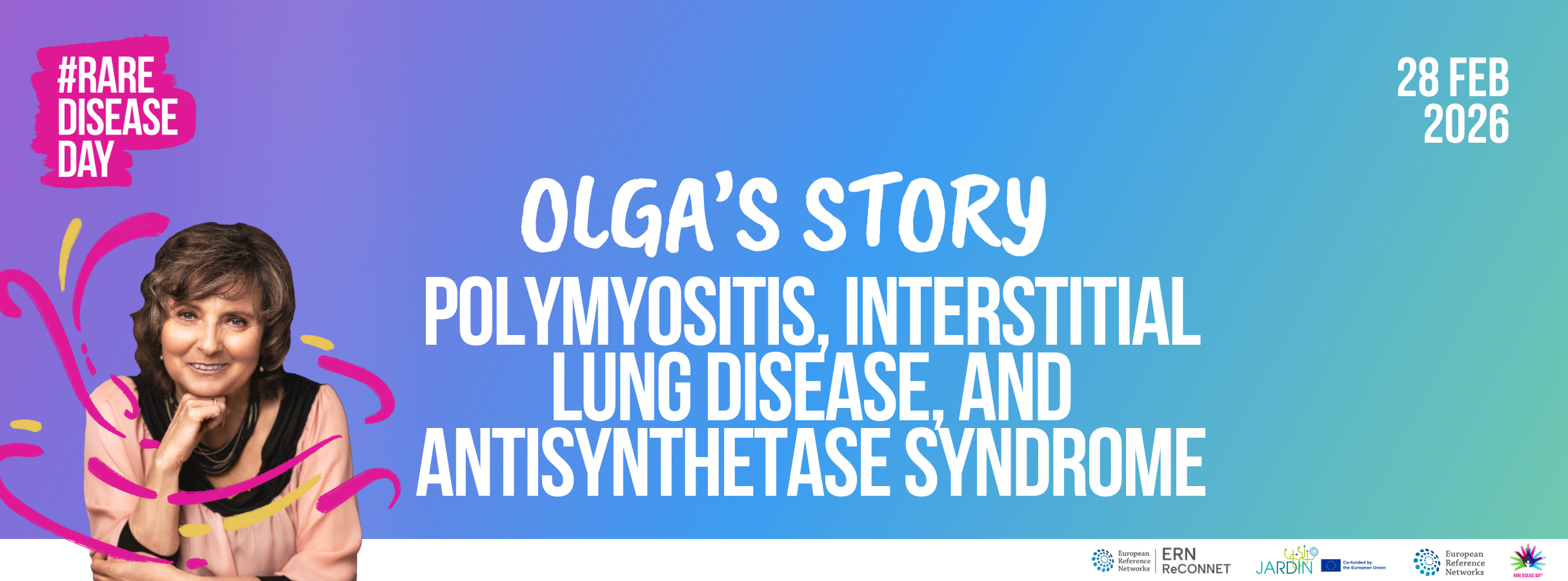
My first symptoms appeared in the fall of 2013. With the onset of colder autumn weather, I experienced painless muscle weakness, extreme fatigue, and joint pain. The small joints on both hands swelled up, and the skin on the sides of my fingers became rough and started to crack. I visited my general practitioner, who then referred me to a local rheumatologist. He attributed my health problems to my age, which hurt me deeply. Unfortunately, he was unable to diagnose me or prescribe effective treatment. My health continued to deteriorate, which limited my mobility—I couldn’t get out of the car, climb out of the bathtub, dry my hair, and even the smallest number of stairs or a small hill caused me enormous problems. Gradually, I became dependent on the help of others. It was the most complicated period of my life. I felt helpless and hopeless. “Will I be able to walk? Is there any treatment? Will I be able to take care of myself or will I be dependent on others? What about my demanding job?” Many such thoughts constantly gnawed at my mind, and the enormous uncertainty brought me to rock bottom.
During my hospitalization at a specialized medical center, I learned my diagnosis. It was – polymyositis, antisynthetase syndrome, and interstitial lung disease. After eight months of a difficult period, I felt enormous relief. It sounds strange, but that’s exactly how it was.
I was convinced that I was in the hands of experts who would bring me back to life, and that is what happened. However, one moment took me by surprise and brought me to tears. When I was discharged from the hospital, I was told that my illness was incurable. Although I was aware of this information, at that moment I couldn’t control my emotions and let them run free. Gradually, I absorbed this information and came to terms with it. I even think it made me stronger in the end.
The treatment and care I receive is based on the high professional level of the specialized centre and, above all, on the expertise and human approach of my rheumatologist.
From a young age, I gradually developed a stereotypical perception of doctors: “a frowning, tall, perhaps even slim man in white” – yes, that is exactly the image that remained in my memory. Unfortunately, in the early stages of my illness, I encountered a similar doctor again. Later, I had a more positive experience.
I remember it as if it were yesterday. I was lying in a hospital bed in a specialized ward. One gloomy morning, the door suddenly opened and a “man in white” entered the hospital room. His appearance immediately caught my attention, and his behaviour was somewhat unusual and unexpected for me. He shook my hand, introduced himself, and officially told me my diagnosis. He then described the treatment to me. I was given the opportunity to ask questions. At that moment, I couldn’t think of any.
It was almost the first time in my life that I had encountered such refined behaviour, empathy, and humanity on the part of a doctor. Afterwards, I wasn’t sure if what had happened in the hospital room was real or perhaps a dream. Evidently, my imagination was dominated by ingrained stereotypes about doctors, and his behaviour completely took me by surprise. The treatment began to work, and after a long time, I was able to start living and working normally, within certain limits. Polymyositis, interstitial lung disease, and antisynthetase syndrome—these strange-sounding, completely unfamiliar, and incomprehensible terms became part of my vocabulary, and I gradually began to understand them.
I visit my rheumatologist’s specialized clinic regularly every three months. Before each visit, I get a strange feeling. My stomach is always filled with a fluttering sensation, fearing that the “man in white” will discover some other health complications related to my illness. The moment I enter the clinic, his invisible aura relieves me of all my anxiety and I am able to engage in normal conversation. I always write down the questions I don’t know the answers to on a piece of paper so that I don’t forget any of them. On the way home, I recap the entire conversation and try to remember the whole course of our discussion. I repeat some sentences several times and keep coming back to them. Miraculously, almost unbelievably, each meeting encourages me and brings me new energy. The entire period between visits, I always live off the previous one.
From time to time, when my rare disease makes itself known, reminding me that it exists, that it is here and that it must be taken into account, I find help from “my rheumatologist.” Over time, the stereotypes I had in my youth have changed. Now I believe that there are doctors who, through their behaviour and approach, have a positive influence on the treatment of patients. In my case, this is quite obvious. My rheumatologist has become part of my life and accompanies me on all my journeys. He taught me to live with a rare disease, to listen to my body’s signals, and, most importantly, he brought me back to life.
In general, not only a professional but also a “human” approach by a doctor to a patient is beneficial in all respects and has healing potential.
My active involvement in ERN ReCONNET activities, a patient organization and international projects brings me new information about my disease and, above all, hope for safer treatment in the years to come


