 CONTACT




- ERNs
- Patient Stories
- KONSTANTINOS’S STORY
KONSTANTINOS’S STORY
- February 19th, 2026
- MetabERN. ERN on hereditary Metabolic disorders
-
 Greece
- Share
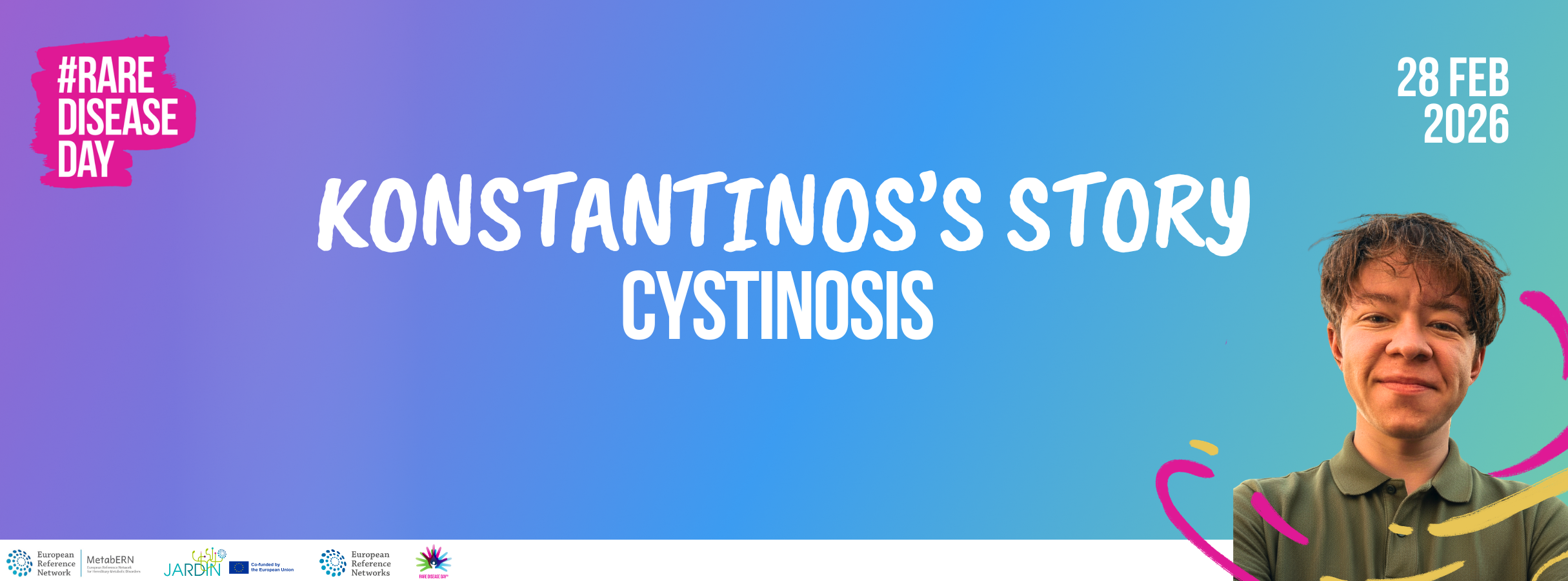
Hello there! I’m Konstantinos, I’m twenty-two and I’m majoring in Physics. I live with a rare disease called Cystinosis since… well, since I can remember myself really.
It all started when I was about one and couldn’t stand without support, whilst other children my age were already running around giving their parents headaches. My parents young and I being their first child, had no way of knowing something was amiss. Our neighbour at the time, Mrs Georgia, a woman who had raised many children and grandchildren, took a good look at me one day and told them that something wasn’t right so help was sought at a university pediatric dept. Cystinosis is an ultrarare disease affecting about one person in every one hundred to two hundred thousand live births so we were very lucky in that there was a metabolic specialist in the department (the only one in Northern Greece) who immediately guessed the correct diagnosis which was confirmed by DNA analysis at a metabolic centre in Lyon. Very importantly my early diagnosis enabled specific management from very young.
From that moment I had a diagnosis, which is both a useful thing and a burden. For a long stretch of childhood I managed to keep my condition controlled, and life felt, if not normal, then adjacent to it. Then came adolescence, and what is a teenager without some rebellion? So, I rebelled! I rebelled against pills and schedules, and around the age of sixteen my kidneys began to fail. For a year and a half I sat hooked to a dialysis machine and watched my blood leave my body, pass through a device that did the work my kidneys no longer could and return to me cleansed of the poison it had been carrying. Then, at eighteen I received a kidney from a deceased donor, and it rather changed my life.
Since the transplant, I take immunosuppressants, which are drugs that keep my body from identifying the new kidney as a foreign invader and then launching a full-scale attack to eliminate it. I have hospital appointments for monitoring about once a month. Also, every twelve hours I take cysteamine to prevent cystine crystals from accumulating inside my cells. Whilst these medications can sometimes (like really) upset my stomach, otherwise I think I’m doing adequately overall.
This whole affair has introduced me to some remarkable people who changed how I see the world: doctors, nurses, hospital staff, fellow patients and their families. Greece has some excellent people working on rare diseases! The challenge is that they’re often scattered across separate institutions. What patients need are networks that connect these experts to one another, so that knowledge can flow between them and treatments can reach those in need. The European Reference Networks exist precisely for this purpose. Stronger links with such networks could mean the difference between simply managing a disease and actually living well with it.
Sometimes I find myself asking “why me?”, and I think this is a question that every person with a serious illness, or every person with any problem for that matter, eventually poses to whatever they believe might be listening. But if I’m honest, my condition has shaped me into whoever I am. I don’t mean this in some sentimental way where suffering becomes a gift we’re supposed to be grateful for. What I mean is that Cystinosis taught me things most people my age have never had the chance or even the need to learn. It gave me a sense of how important health truly is, and I tasted mortality sooner than most. If some god offered me the choice, would I embrace this condition? Most likely not. Yet I cannot picture myself without it. Perhaps that person would be happier, or mayhaps he would be someone I despised. It’s like the Grandfather Paradox (for all my Physics nerds out there). There is no way to know. Perhaps some questions are better left as they are… questions.
The future, as I see it, holds both great promise and great uncertainty, and I try not to dwell on the uncertainty part because that way lies a kind of paralysis that helps no one. Some of the things I look forward to is what advances in medical technology might offer: artificial organs, better treatments, perhaps even cures and of course there is the world’s favourite new toy, AI, which might solve all of our problems or create new ones we cannot yet imagine or both at the same time.


