 CONTACT




- ERNs
- Patient Stories
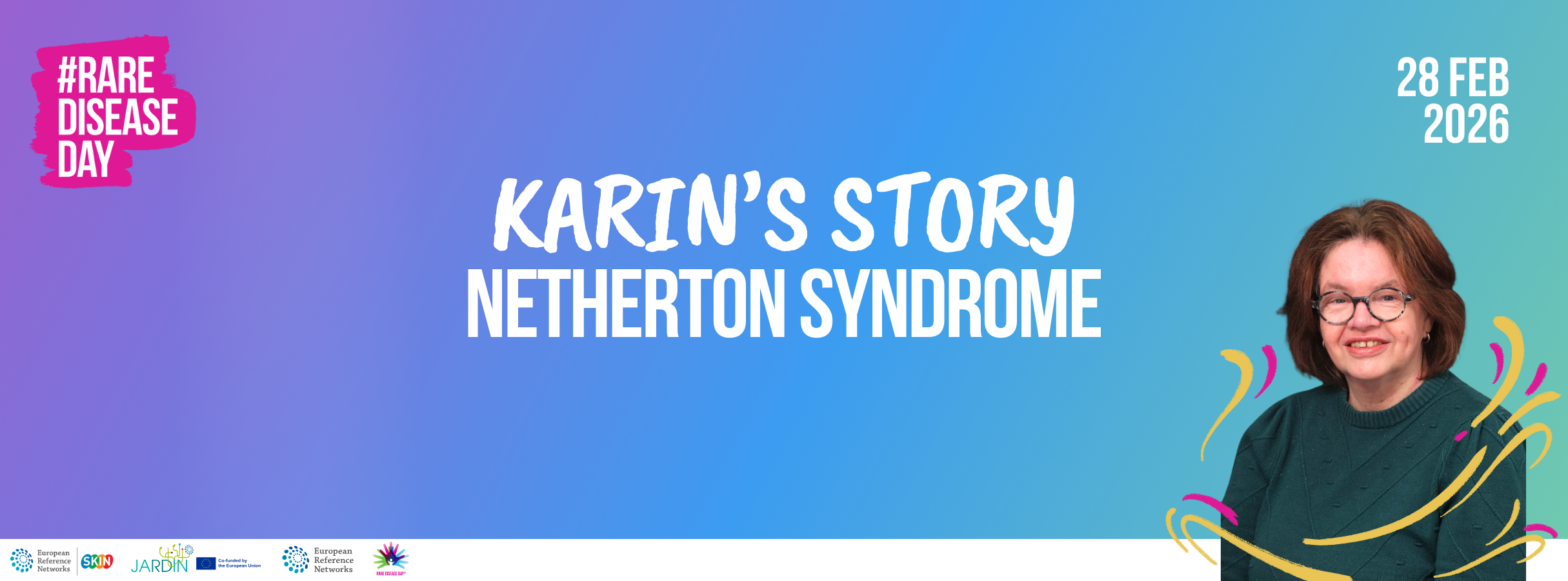
- KARIN'S STORY

My life with Netherton syndrome
My name is Karin, I represent rare skin diseases within the European Reference Network Skin. I am president of the Dutch patient organisation Vereniging voor Ichthyosis Netwerken and vice president of European Network Ichthyosis. Besides that, I am president of the Dutch umbrella organisation Huid Nederland.
I live with a rare skin condition called Netherton syndrome, recently renamed as SPINK5-sEDD. I was born in 1969 and diagnosed in 2009, a few months before I turned 40. Why did it take so long to get a diagnosis for a disease I was born with? And why was my gene mutation discovered in Paris and not in the Netherlands?
When I was young, nobody knew what was wrong with my skin. I turned red right after birth and my skin looked like parchment paper. My mother had to soak my clothes off, because they got stuck to my body every after every change. She visited several doctors, they thought of eczema. After trying a lot of treatments, the pedeatrician prescribed the strongest steroid cream…and it worked very well. But this had a very severe side effect nobody was aware of: adrenal insufficiency. It was in the early ‘70s, that I saw a lot of hospitals from the inside. At primary school I was bullied a lot, children thought that I was covered with flees because of all the itching.
I grew up with a lot of skin problems, allergies, overheating and no diagnosis. I only had to think about a bacteria and I had an infection. Besides that, I developed severe asthma. In Groningen Medical Center they discovered I had bamboo hair and some type of ichthyosis. Nevertheless, I went to college, got a job in healthcare for people with intellectual disabilities, and enjoyed it. Only the constant skin rash and other health issues made me very tired. I decided to retrain for a management position. Where there’s a will, there’s a way, I thought. I worked until 2009, then I became ill. It turned out I had burnout, combined with PTSD (post-traumatic stress disorder).
In 2005 my skincondition exacerbated, the General Practitioner prescribed a class 3 steroid cream. I used it and within a couple of days my skin was covered with ‘blisters’. The dermatologist was in shock when he saw me and called it severe impetigo bullosa. I was put on oral antibiotics for weeks. My legs were swollen for weeks. Because I reacted more and more allergic to all kind of skin emolients I searched for my symptoms on the internet. On a website about ichthyosis I learned about Netherton Syndrome, a swedish article. It described everything I was experiencing: skinproblems, allergies, ILC (Ichthyosis Linearis Circumflexa), bamboo hair, asthma, heyfever, overheating, etcetera. The local dermatologist told me, I could not have it…….
I asked my General Practitioner to refer me to the university hospital again. The first doctor who saw me was German, she said, without looking in my DNA: “Sie haben Netherton Syndrome”. DNA testing was a problem, until it was done in France…….
So, before the European Reference Networks even existed, ‘teamwork made the dream work’! And I am so happy to be part of this team now, It is very special to meet all the people who were involved in my own diagnosis and to be part of their team now!
Let me jump back a bit in time: in 2015, we launched the Verenigigin voor Ichthyosis Netwerken in the Netherlands, and in 2019, I attended my first European Reference Network meeting in Paris. Since then, I’ve grown even more in my role as a patient representative, both nationally and internationally. In recent years, we’ve jointly organised two international online conferences for people living with Netherton syndrome and their relevant professionals. I was involved, along with fellow patient representatives, in updating the ichthyosis management guideline. I even had the opportunity to give a presentation during the scientific days about collaborating on the “Quality of Life with Ichthyosis” questionnaire.
I was bullied immensely because of my condition, and it forever marked my life. I was sometimes asked to explain my condition in class, but that made me even more of an exception. When I heard from dermatologists that knowledge about skincare in general wasn’t that great, I teamed up with the team at Huid Nederland (Dutch Skin Alliance) to develop a curriculum for primary school students. A fantastic group of teachers, patient advocates, dermatologists and other medical professionals, a teaching assistant, and a critical youth council have jointly created a high-quality and unique program: Skin at School. We cover general skin care, sun protection, and both temporary and chronic skin conditions. My wonderful colleagues at ERN-Skin collaborated on lessons on topics including epidermolysis bullosa, congenital naevus, vascular malformations, albinism, and ichthyosis. Every child should experience social safety at school!
I believe that collaboration within the European Reference Network leads to better care for people with rare skin conditions, and I’m happy to participate from a patient perspective.
Is the work we do being noticed? I think so! In February 2025, I was recognised in the Netherlands for my commitment to rare diseases and skin conditions with the Rare Engel Award. In April, I and my colleague Marie-Claude received an award for international collaboration from Global Skin, the global organisation for skin patient representatives.
Unfortunately, I pay a price for my work. My health is poor, and we’re committed to rare, non-profit work that we do with a limited group of people. This not only takes time, but sometimes it also comes at the expense of my health.


