 CONTACT




- ERNs
- Patient Stories
- FRANCESCO'S STORY
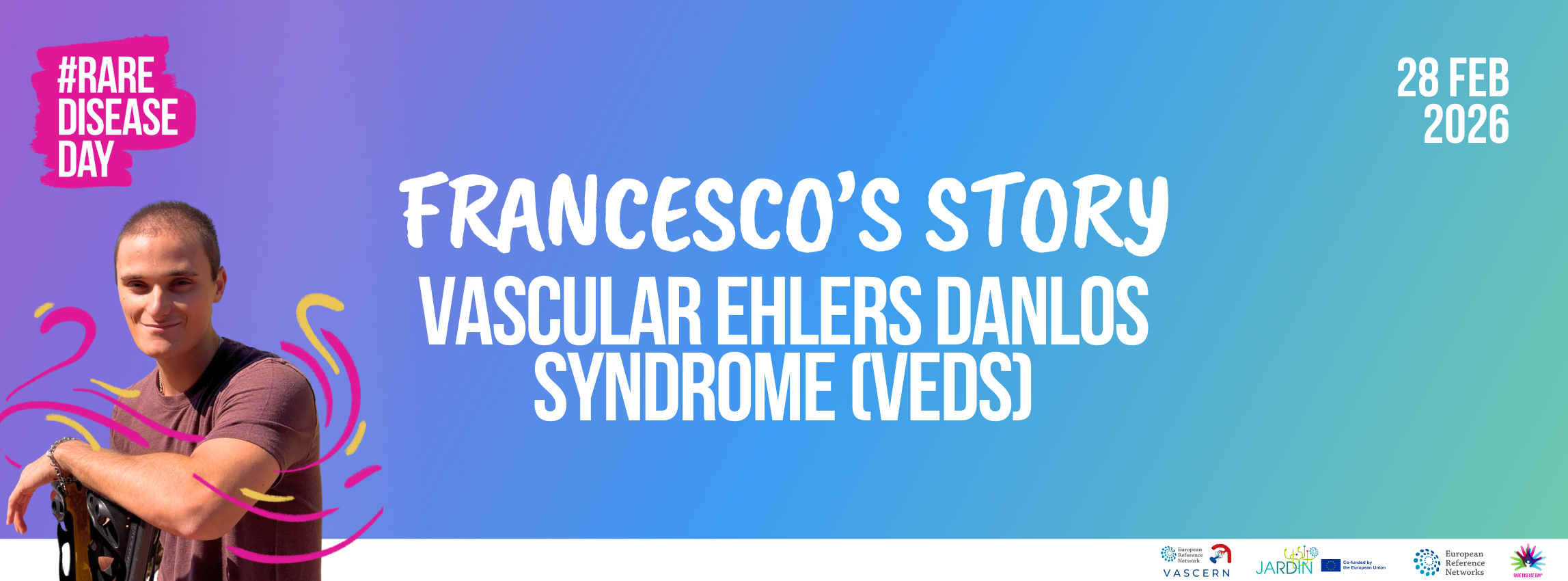
By Alessandra – Francesco’s mother
I’m mom of Francesco, a 20-year-old boy with Vascular Ehlers Danlos Syndrome (VEDS).
This is his story from a mom’s perspective, but let me say that he’s currently studying Biotechnology at the University to become a researcher in the field. So maybe, in the future, you’ll hear more directly from him.
Vascular Ehlers-Danlos syndrome (VEDS) is a rare genetic disorder caused by defects in type III collagen, leading to arterial fragility and a high burden of potentially life-threatening vascular events. Because this collagen type is present throughout the body, vEDS can affect multiple systems, including arteries, hollow organs, skin, and lungs, all of which may be prone to spontaneous rupture.
Managing VEDS is challenging. It requires a careful balance between preventing severe complications and minimizing the risks associated with medical interventions. Early diagnosis is crucial, as it allows timely referral to expert centers where multidisciplinary care, genetic counseling, mental health support, and structured long-term follow-up can be provided.
My son was born prematurely and underwent surgery for two inguinal hernias at just one month of age. His childhood appeared mostly normal, aside from recurring issues that were repeatedly indicated as “typical for children”: unexplained and extensive bruising, spontaneous muscle ruptures, and chronic deep pain in his legs and back.
I clearly remember one vaccination appointment being postponed due to the severity of his bruises. At one point, a preliminary investigation for possible abuse was initiated, a deeply distressing experience that was fortunately closed at the following visit when the bruises had disappeared. However, you never know what VEDS bruises are going to do.
During adolescence, his health deteriorated dramatically. At the age of 15, he was hospitalized four times within six months due to unbearable pain in his back and legs, accompanied by tremors, muscle stiffness, retractions, and spontaneous muscle ruptures. He underwent countless assessments and trial treatments, as doctors struggled to identify the cause.
Eventually, a geneticist was consulted. After listening carefully to his medical history and observing physical features such as translucent skin with increased vein visibility, the geneticist ordered genetic testing for collagenopathies. During this visit I was also asked if my son was sleeping with his eyes open. “Since when he was a baby,” I answered. Strangely, this was a clue for the doctor, as in VEDS it may also happen there is a reduced eyelid closure.
One year later, the diagnosis arrived: a pathogenic variant of the COL3A1 gene, VEDS. However, the relief of finally having a diagnosis was brief, as we immediately began to grasp the seriousness and lifelong implications of the disease.
Although the children’s hospital confirmed the diagnosis, the rarity of VEDS meant they referred us to a specialized center located three hours from our home, a center with sufficient experience in managing the disease and its many comorbidities. This marked the beginning of a new chapter.
The specialized center enrolled my son in a structured, long-term follow-up program, which has proven extremely effective. The medical team shared essential guidance on daily management and risk reduction. However, it soon became clear that many comorbidities would need to be managed locally, where there is a significant lack of healthcare professionals experienced in VEDS. This challenge is common for people living with rare diseases, particularly those who live far from expert centers.
Seeking information and support, I contacted AISED, the Italian Association for Ehlers-Danlos Syndrome. With their encouragement and support, I applied to become a European Patient Advocacy Group (ePAG) representative within VASCERN, the European Reference Network for rare multisystemic vascular diseases.
Since joining VASCERN, I have witnessed the power of collaboration among patients, caregivers, healthcare professionals, researchers, institutions, and coordination teams. Together, we work to respond more effectively to the needs of people living with this kind of rare diseases. We share the goal of improving quality of life and equity of care across Europe.
Within VASCERN, specialists use the Clinical Patient Management System (CPMS), an IT-based telemedicine platform that allows doctors across the EU to discuss complex cases and receive expert advice across borders. ERNs also develop transnational registries that collect pseudo-anonymized data on patients with rare diseases. These registries enable data sharing with researchers, public authorities, industry, and other stakeholders, driving improvements in care and advancing research.
On advancement, since I joined VASCERN, their researchers have conducted a controlled trial demostrating that, compared with placebo, an angiotensin II receptor blocker reduced the risk of severe symptomatic and asymptomatic arterial events in elegible patients with VEDS on background celiprolol therapy.
Equally important are education and training initiatives. VASCERN invests in spreading expert knowledge through webinars, conferences, clinical exchanges, and accredited educational activities for healthcare professionals, young doctors, and medical students. Several tools developed for both clinicians and patients are made available on the VASCERN website, often translated into local languages, and a lot more have to come.
Patient advocates are an active and integral part of this work. Together, we form a strong alliance striving to ensure equitable access to harmonized care and treatment for people living with rare diseases across Europe and, hopefully, beyond. For all the above reasons, I take this opportunity to express my gratitude to every single person I’ve met in VASCERN for their collective efforts.
Most rare diseases still have no cure. Yet, through collaboration and shared expertise, we contribute every day to advancing knowledge and improving medical options. For me, knowledge is hope and reassurance that things can change and care can improve.


