 CONTACT




- ERNs
- Patient Stories
- FILIPPO'S STORY

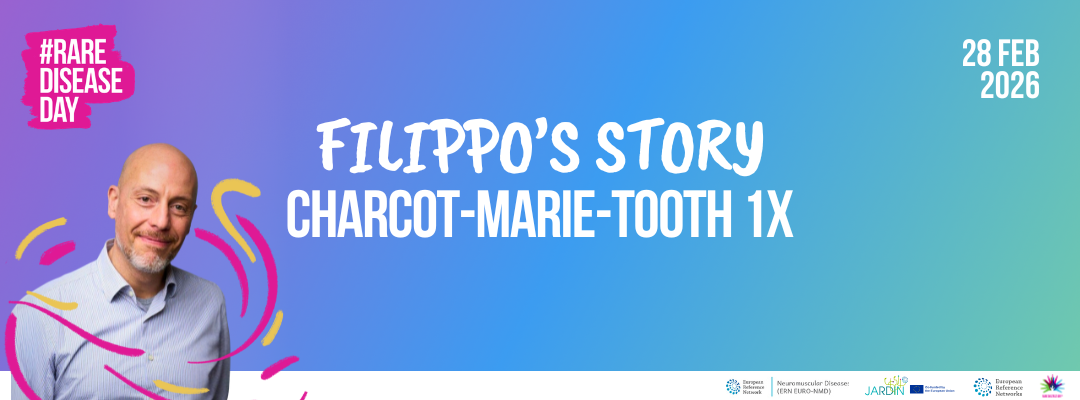
Bridging the Gap: From Isolation to European Advocacy
My story begins like that of many other patients with a rare disease: with a wobbly step and a path full of uncertainty.
The symptoms of Charcot-Marie-Tooth (CMT) appeared with my very first steps. As a child, I walked on my toes, displaying a clumsy gait that would later become a defining feature of my life. At the time, I didn’t care much—I was just a child. But as adolescence arrived, the physical differences became impossible to ignore. That was perhaps the darkest period of my life. In an age where one is desperately searching for their place in the world, I constantly found myself coming up short in comparison to others. I struggled with sports, I walked with difficulty, and I was often marginalized. Looking back, I realize that I often isolated myself to avoid the pain of judgment.
The thing I reproach CMT for the most is taking away my free will—the ability to simply choose a sport or a career without a second thought.
It felt as if destiny had handed me a deck of cards, and while I was busy choosing, it snatched them away one by one without warning. It is a frustrating game of “she loves me, she loves me not,” where you count the petals of the things you can still do, constantly adjusting the aim of your dreams to fit a shrinking target.
The medical journey was equally disorienting. My family and I navigated a maze of contradictory reactions: from the specialist who scolded me, claiming it was “my fault” that I walked badly, to the terrifying ten-minute visit where a doctor sentenced that I would die shortly. This lack of clear, validated information is a trauma that many rare disease patients share, and it creates a profound sense of loneliness.
However, resilience is often born from necessity. I built a “suit of armor” from those difficult years and learned that while I cannot fly, I can still move forward. I realized that diversity can be an added value if you do not set limits a priori.
Today, that isolation has been replaced by a powerful network. My frustration with the lack of answers in my youth transformed into professional action. I currently serve as the President of the European CMT Federation (ECMTF) and as the Chief Scientific Officer of ACMT-Rete in Italy.
Awareness of my rare condition is the realization of a bridge that was missing in my youth.
Within the ERN, I serve as a Patient Representative involved in the Peripheral Nerve Diseases Working Group. This role allows me to transform my personal struggle into collective support. I work to ensure that the next generation does not have to face the diagnostic odyssey and isolation that I did. The ERN connects the patient community with the best researchers and clinicians across Europe, ensuring that expertise is no longer a matter of geography. It validates our experiences and gives us a seat at the table where decisions about research and care are made.
I hope that my work contributes to a future where the disease influences life less and less. I want to continue doing the things I love and fully enjoy this life, which, despite the wobbles and the challenges, remains a wonderful experience.
Colmare il vuoto: dall’isolamento all’advocacy europea
La mia storia comincia come quella di tanti altri pazienti affetti da una malattia rara: con un passo incerto e un percorso pieno di dubbi.
I sintomi della CMT sono comparsi già dai primi passi. Da bambino camminavo sulle punte, con un’andatura goffa che sarebbe poi diventata una caratteristica costante della mia vita. All’epoca non me ne curavo molto, ero solo un bimbo. Ma con l’adolescenza, le differenze fisiche sono diventate impossibili da ignorare. Quello è stato forse il periodo peggiore. In un’età in cui sei alla disperata ricerca di te stesso e del tuo posto nel mondo, il confronto con gli altri mi vedeva sempre perdente. Avevo difficoltà a fare sport, camminavo male ed ero spesso emarginato. Guardandomi indietro, capisco che spesso ero io a isolarmi per evitare il dolore del giudizio altrui.
Forse la cosa che più rimprovero alla CMT è l’avermi tolto il libero arbitrio: il non poter scegliere liberamente che sport fare o che carriera intraprendere senza pensarci due volte.
È come se il destino mi avesse porto un mazzo di carte e, mentre ero lì a scegliere, me le avesse tolte via una per una, senza preavviso. È un frustrante gioco di “m’ama non m’ama”, dove conti i petali delle cose che sai ancora fare, correggendo continuamente il tiro dei tuoi sogni per adattarli a un bersaglio che si rimpicciolisce.
Il percorso medico è stato altrettanto disorientante. Io e la mia famiglia abbiamo navigato in un labirinto di reazioni contraddittorie: dai rimproveri del luminare di turno che diceva fosse “colpa mia” se camminavo male, al terrore di una visita di dieci minuti in cui un medico sentenziò che sarei morto da lì a poco. Questa mancanza di informazioni chiare e validate è un trauma condiviso da molti pazienti rari e crea un profondo senso di solitudine.
Tuttavia, la resilienza nasce spesso dalla necessità. Mi sono costruito una “corazza” in quegli anni difficili e ho imparato che, anche se non so volare, posso comunque andare avanti. Ho capito che la diversità può essere un valore aggiunto se non ci si pone limiti a priori.
Oggi, quell’isolamento è stato sostituito da una rete potente. La frustrazione per la mancanza di risposte della mia gioventù si è trasformata in azione professionale. Attualmente ricopro il ruolo di Presidente della European CMT Federation (ECMTF) e di Direttore Scientifico di ACMT-Rete in Italia.
La consapevolezza della mia malattia rappresenta quel ponte che è mancato nella mia giovinezza.
All’interno della ERN, opero come Rappresentante dei Pazienti nel Working Group dedicato alle Malattie del Nervo Periferico (Peripheral Nerve Diseases). Questo ruolo mi permette di trasformare la mia lotta personale in supporto collettivo. Lavoro affinché la prossima generazione non debba affrontare l’odissea diagnostica e l’isolamento che ho vissuto io. La ERN connette la comunità dei pazienti con i migliori ricercatori e clinici in Europa, facendo sì che l’eccellenza non sia più una questione geografica. Valida le nostre esperienze e ci offre un posto al tavolo dove vengono prese le decisioni sulla ricerca e sulla cura.
Spero che il mio lavoro contribuisca a un futuro in cui la malattia influenzi sempre meno la vita. Voglio continuare a fare le cose che mi piacciono e godere appieno di questa vita che, nonostante i barcollamenti e le sfide, rimane un’esperienza meravigliosa.


