 CONTACT




- ERNs
- Patient Stories
- EVA-MARIA'S STORY
EVA-MARIA’S STORY
- February 03rd, 2026
- ERN EURACAN. ERN on adult cancers (solid tumours)
-
 Finland
- Share
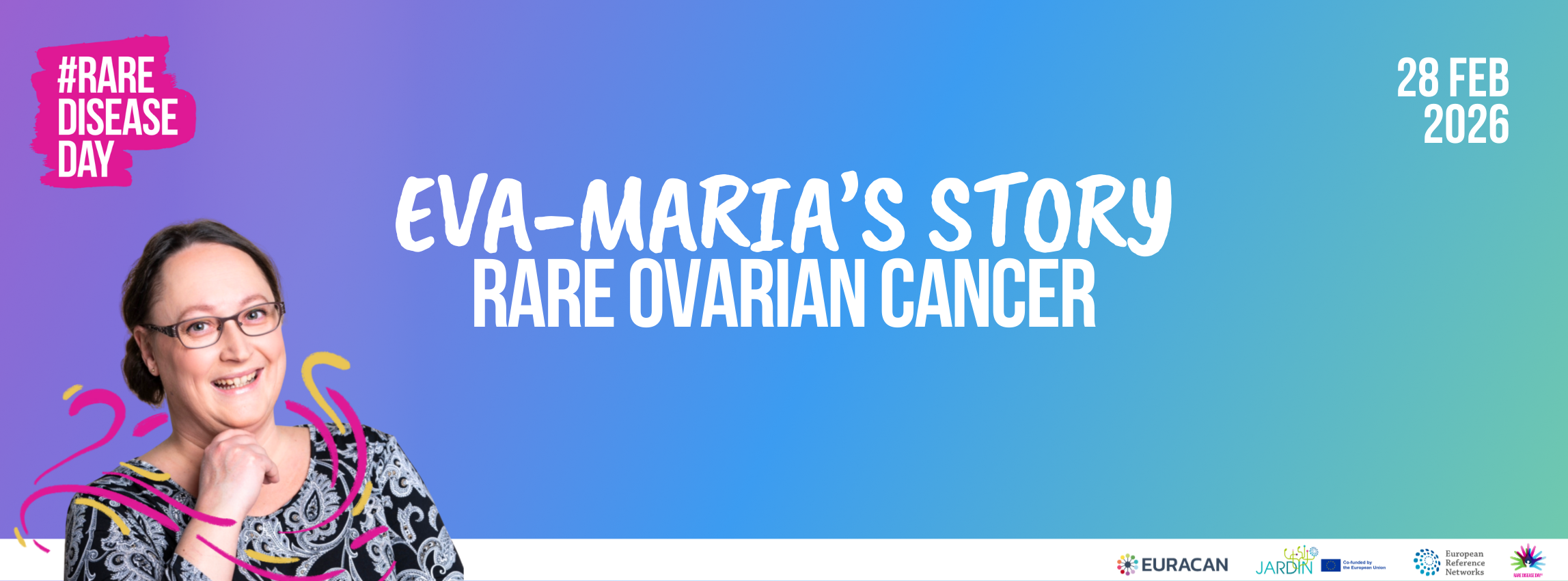
My name is Eva-Maria, a 44 year old woman from Finland. I am a teacher and have a masters’ degree in developmental psychology. I am a nurse specialised in cancer care.
In 2008, I was diagnosed with a rare ovarian cancer called Dysgerminoma at just 27 years old. I did not feel that anything was wrong. I was then a healthy athlete with no symptoms. In a regular checkup the doctor felt something in my stomack and I went to have an ultrasound. A big mass appeared in my one ovary but they thought it was a benign cyst. I went to a surgery but after pathology answers, I got the information that this was a rare ovarian cancer. It was a big chock for me because I had no symptoms and I was in good shape.
From beeing a healthy ahtlete I went to being a sick cancer patient overnight. It was hard to tell my family and friends. I underwent another bigger surgery and they took away my ovary, omentum, appendix and lymfnodes. The cancer had not spread and I did not need any treatments.
However, after 6 months I got pain in my back and the ultrasound showed a big mass on my kidney. I did right away understand that the cancer had come back. I underwent my third surgery within one year and after the surgery I was in quite bad shape since they also took away one kidney.
This time, I had to get treatment. So I got three different chemotherapy in three months for over twenty times. Then, I was a bed patient and needed help all the time. I got many severe side-effects from the chemotherapy. It took half a year before I was quite normal again but I had severe fatigue and thyroid problems and medication.
Four years ago I also got another cancer diagnosis. This time thyroid cancer, implying surgery and treatment. It was not a rare form of cancer but still another cancer to deal with.
Those are just some of the problems and challenges a patient with rare cancer faces. We need more cooperation between doctors and cancer centers in Europe but also more cooperation between patient advocates and doctors in the rare cancer field. We, ePAGs, have much knowledge and we are willing to help and cooperate. It is important to get together so that other rare cancer patients do not have to face all the same challenges and problems.
Because of the treatments and medications from my rare cancer I got many side-effects that impact my daily life now also many years after treatment. After my surgeries I got into menopause at 27 years old and had to deal with all that. I also knew I can not have children anymore. Because of all long-term side effects, like fatigue, I can not work full time so I am working 50% as a nurse.
My rare cancer has had big impact on my life, both negative and positive. The positive is that I now can travel and participate in events to tell about my own cancer story to others. I can also be part of expert groups regarding rare cancers and cancers in general. I give lectures about quality of life, long-term side effects, rare cancers, rehabilitation and much more that relates to cancer, care and the patients’ well-being. I am sitting in different cancer boards, working groups and expert groups in Finland, Europe and beyond.
To have a rare form of ovarian cancer at a young age was difficult. The challenges were many. First the doctors where not used to meeting women with rare gynaecological cancers and they had not enough knowledge about this form. But I had a good doctor that also looked after information from other countries. Because my cancer was rare, there was not so much information for me as a patient and no other women that I could talk to. This was year 2008 and I know it is much better now. But still, there are women reaching out to me saying that they feel alone and lost because of the lack of information about their rare cancer.
Challenges are also the lack of clinical trials and the lack of early diagnosis and correct diagnosis. I also got wrong diagnosis in the beginning when they thought it was a benign cyst. Another challenge is that a patient with a rare cancer probably has to travel far to get the right care and treatment. This means that he or she has to be alone, far away from supporting family and friends. Peer-support is also too hard to find and the primary healthcare has not enough of knowledge about rare cancers.


