 CONTACT





- ERNs
- Patient Stories
- ELISABETH’S STORY

Our story began in 1987. In autumn that year, my husband had strange headaches during a whole weekend that nothing could stop, bringing him to bed.
I was at the end of my medical studies to become a child psychiatrist, and my last internship at the hospital was in a neurology department. So, after the weekend, I phoned the department and the head of the department examined my husband, who felt good again, just a bit tired.
He found nothing special but decided to request an EEG and a scan. The EEG was normal, but the scan was totally abnormal with a diagnosis of “leukoencephalopathy”, unrelated to his clinical condition. It was decided that my husband had to be hospitalized for a complete check-up. Among many examinations, he had an MRI, which was new in Paris, and the images confirmed the scan results.
The results were shown to various neurologists, and all of them were astonished by these images, which did not correspond to my husband’s clinical situation: he worked normally as an engineer with a demanding position, and he looked after our children (three, between 15 months and 9 years old), even alone when I was on duty.
Finally, it was decided to wait one year and do another MRI. Throughout that year he was in good health. The new MRI in November 1988 showed the same images, and ultimately the different neurologists thought the abnormal findings were related to fetal pathology and that his condition was stable.
Life went on. We had a fourth child in 1993. Then in 2006, during the spring, I suddenly got worried about a few little things that made me feel a slight difference in my husband’s behaviour. I called a close friend, also a psychiatrist, telling him I was worried and asking myself if what I was feeling had a link with what happened 20 years ago. He reassured me saying my husband had always been a bit of a dreamer and that he didn’t notice anything.
At the end of the summer, we spent a few days holidays with my parents, who were around 90 years old, and the daughter of my husband’s oldest sister (this sister was 75 years old). This niece told me she was truly astonished to see my parents going to the market, cooking —she told me that her mother was no longer able to do anything and could no longer live alone. She asked me “the question”: “Don’t you think there is a link with CADASIL?” I had never heard of CADASIL before. She only knew that her mother had CADASIL, that it might be a family disease, and she asked me “the second question”: “could you look up what it is, and explain me?” The illness was named in 1996.
At that time, we did not have internet on our mobiles. When we were back home, I researched on Orphanet. In 2006, the Orphanet title was: “CADASIL: Dementia”.
I read the entire article and understood that my husband has CADASIL too.
That day began a difficult pathway. I felt like I was holding a secret about my husband: I knew something about him that he didn’t know. After a couple of days, I began to talk to him about CADASIL. There is no good way to talk about this, and it was not easy. My husband didn’t believe me and didn’t want to consult the reference centre in Paris. I got worried about the future of our children and asked him to call his sisters. After one or two month he agreed. He called one of his sisters and asked her, “What about the children?” She answered that the children had nothing to do with CADASIL. I was sure this was wrong, but he trusted her. In fact, she said what he wanted to hear, but I could not accept this as I was too worried.
My husband finally agreed to consult at the reference centre, and we got an appointment in March 2007. The way we were received, clear and accurate on the medical aspects and with empathy, really helped us. The professor in charge explained to both of us what CADASIL means, and we met the psychologist the same day. We talked with her about our children: what to tell them, how, and when? Our three older children were going through particularly important and difficult times in their studies, and our son, the youngest, was not yet 14 years old. We both remember that the psychologist told us: “It is urgent to wait for your children”. This gave us time to talk together and also to let CADASIL enter progressively into our family life. Each time we went to the hospital, we explained to our children that their father needed a hospital follow-up for the health problem he had in 1987. My husband has a very slow-progressing form of CADASIL and he is in good health.
The psychologist also told us about the association, CADASIL France. I first attended the general assembly without being a member yet. It was a warm and reassuring encounter, and we decided to join. A few years later, I became a member of the board. My husband did not want to be an active member, but he follows the different activities of the association. What’s important for us is the connection between the association and the medical and research staff. We both participated in research protocols. We think it’s the right way to help all the patients and also our children.
For three years, I have been a patient representative in VASCERN, and our goal is to support research, facilitate exchanges between different European Countries, and achieve a similar level of medical care across Europe. I also find it valuable to have exchanges with people affected by other rare diseases.
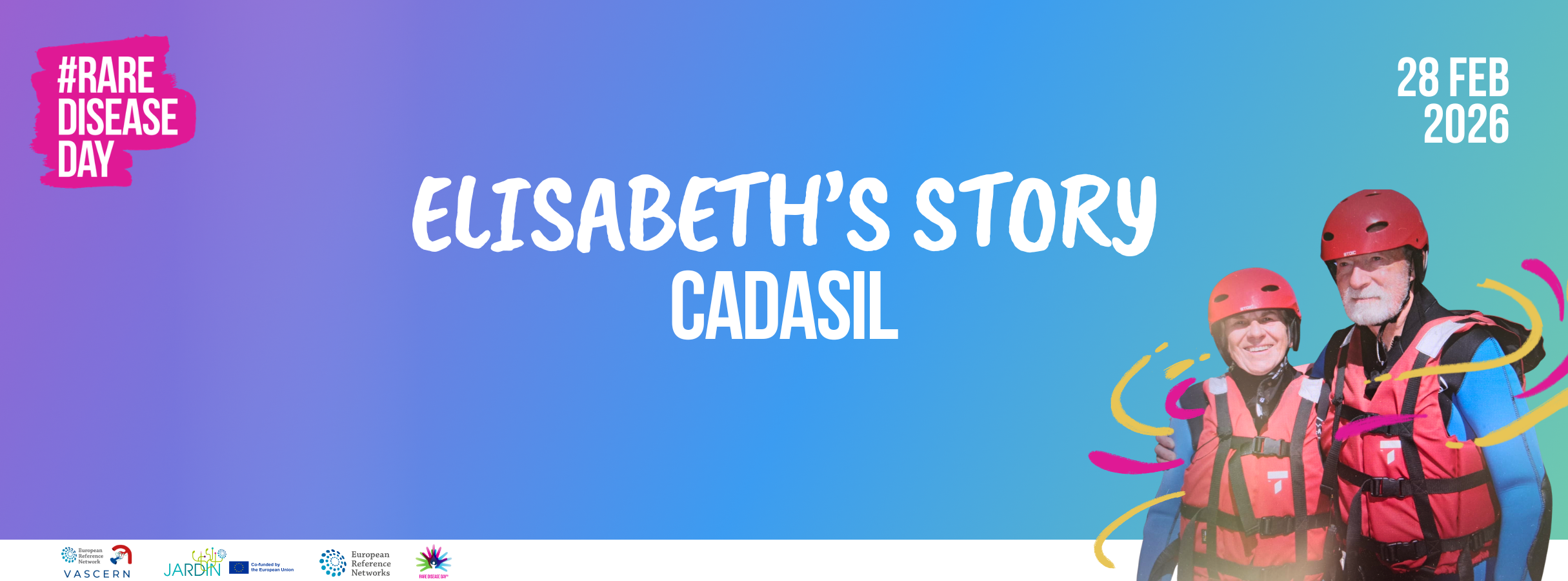
Now my husband has some memories difficulties (but we are no longer young: 77 and 71 years old) and difficulties in planning projects for the future. We are like a small train with a locomotive and a wagon. If the wagon doesn’t follow the locomotive, or if the locomotive doesn’t have any projects, the train will stop. I am the locomotive and he is the wagon, and we continue hiking, cycling, skiing, and looking after our grandchildren.
Both of us are a small team in the big team of ERN against rare disease.


