 CONTACT




- ERNs
- Patient Stories
- CÉLINE’S STORY
CÉLINE’S STORY
- February 02nd, 2026
- ERN GUARD-Heart. ERN on uncommon and rare diseases of the heart
-
 France
- Share
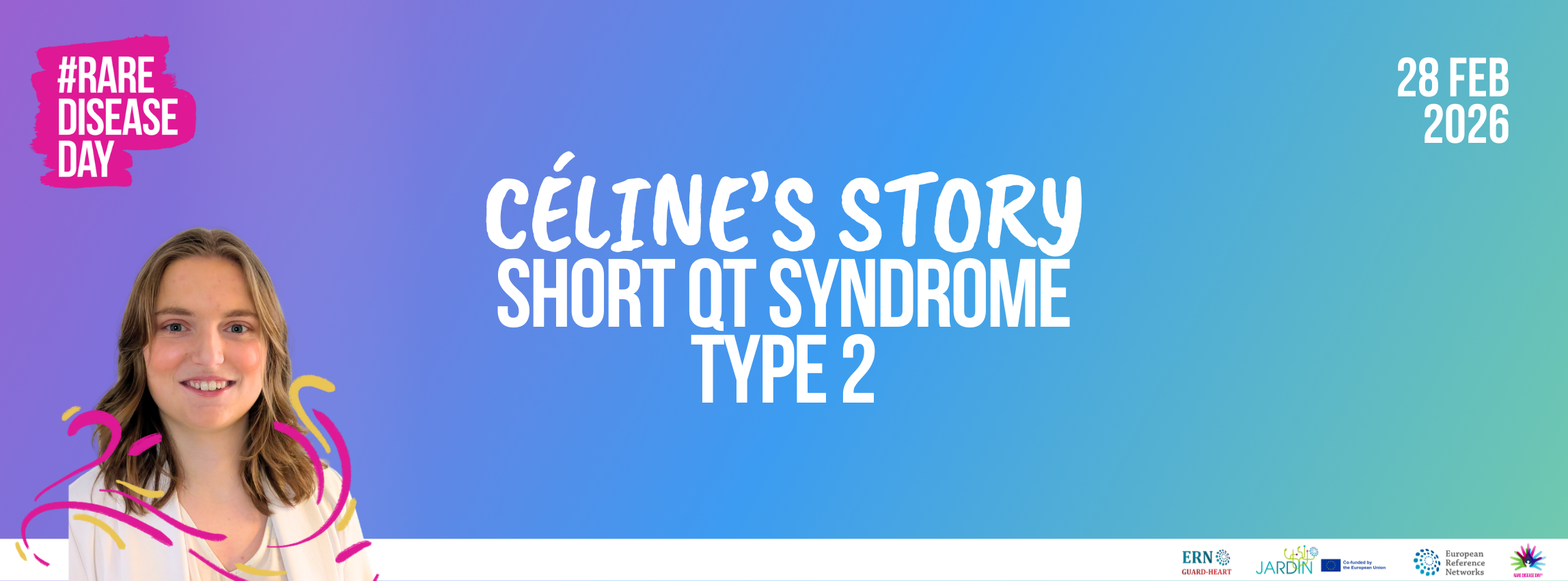
You said “rare,” Céline replies “exceptional”
Question 1: Céline, Can you tell us more about your disease?
Céline: I have been suffering from an extremely rare heart disease called Short QT Syndrome Type 2. I have had bradycardia since birth, so I have had a pacemaker since I was four years old. Since last year, I have also been suffering from permanent atrial fibrillation, and unfortunately no surgery is possible. My heart condition can continue to get worse, and there is a risk of sudden death.
In addition, my inner ear does not function properly, which makes it very difficult for me to move around in the dark. I cannot ride a bike or a scooter, and I get tired very quickly at school, even though I use a computer and have a specially adapted timetable, with some classes at school and others through distance learning.
Question 2: When you say “extremely rare disease,” what do you mean?
Céline: I mean that, for my disease, doctors have recently discovered that there are only 19 known cases described worldwide. Even though I have almost the same cardiac symptoms as the other patients, it also looks like I am the only one with no inner ear! My cardiologist learned to understand my disease as I was growing up. I sometimes wonder if I will ever meet someone with the same disease.
Question 3: What is the most difficult thing for you about your disease?
Céline: The most difficult thing for me is being very, very tired every day and not being able to do the same things as others. I have to come to school by taxi because of my chronic fatigue. I cannot stay for full days at school, and I cannot go on school trips with the others. My disease is invisible, so people do not always understand it, and I have to fight to be able to do things like everyone else.
Question 4: How do you see the future?
Céline: I have plans like other young people my age, but I also know that I may have to give them up because of my disease, which can continue to evolve. I try not to think about it too much and to live my life day by day, because even my cardiologist does not know how the disease will develop.
Question 5: What would you wish for yourself?
Céline: I would like more research to be done on my disease so that one day it could be treated with medication or gene therapy, like for Duchenne muscular dystrophy, since my genetic mutation is known. If I have children one day, I do not want them to suffer from the same disease.
Question 6: What could be done concretely for you today?
Céline: Everyone can learn first aid and fight to equip public places and sports facilities with external defibrillators, so that young people at risk of sudden death, like me, have a better chance of surviving. We can also talk about extremely rare and disabling diseases like mine and raise awareness about the need to find treatments for us too. It is very unfair to see research being done on other rare diseases, like cystic fibrosis or Duchenne muscular dystrophy, while we have no hope of being cured because there is no research on our disease. If we do not look for solutions, we will never find a treatment.
Find out more about Céline’s journey here: https://guardheart.ern-net.eu/2026/01/26/who-are-our-epagscelines-journey-perseverance-resilience-and-hope


