 CONTACT


JARDIN European Solvathon: the next layer for unsolved rare disease patients
October 16th, 2026
-

- JARDIN
- Solvathon
- WP7.1
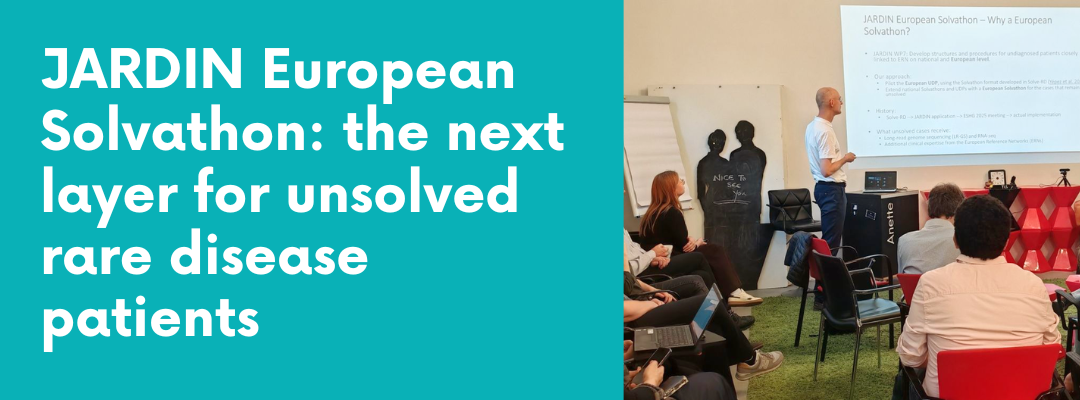
On 5–6 October 2026, more than 30 clinicians, geneticists, bioinformaticians and ERN experts from 11 countries met in Vienna and online for the first JARDIN European Solvathon. The event was organised in Work Package 7 of the JARDIN project as a pilot for a European Undiagnosed Disease Program (UDP). Its core idea is to provide additional data and connect unsolved rare disease cases directly with the ERN experts.
Why a European Solvathon?
Many families living with a rare disease still have no diagnosis, even after thorough local diagnostics and national reanalysis efforts. A European UDP can serve as the next layer for these patients. It brings their cases to a European level and to expertise that is hard to access locally.
The pilot builds on the Solvathon concept developed in Solve-RD: multidisciplinary experts jointly reanalyse unsolved cases in a structured, hands-on setting (Yépez et al., 2025). WP7 adapted this model to the European level and combined it with new data types. The cases brought to Vienna came from the Netherlands, Estonia and Romania. All had remained unsolved after local diagnostics and national UDPs. Where possible, the submitting countries performed additional long-read genome sequencing (LR-GS) and RNA sequencing (RNA-seq) for these families before the event.
The newly generated LR-GS and RNA-seq data were analysed centrally by the Institute of Medical Genetics and Applied Genomics of the University Hospital Tübingen, Germany, and OmicsDiscoveries GmbH, Planegg, Germany. Resullts were provided to the Solvathon participants the GSvar and RNAvision platforms, respectively.
ERN expertise at the core
A key feature of the pilot was the systematic inclusion of additional ERN-based experts, beyond the teams that had already studied the cases. The cases were reviewed in four working groups organised around nine ERN clusters, including ERN ITHACA, ERN-NMD, ERN-RND, ERN EYE, ERN EpiCARE, ERN GENTURIS, EndoERN and MetabERN. In each group, clinical specialists from the relevant ERNs discussed the cases together with the local teams, geneticists and bioinformaticians. This brought disease-specific clinical knowledge into the interpretation of complex variants, which genomic data alone cannot provide.
First results
In two days, the teams reviewed 34 families that had remained unsolved despite thorough investigation. Three families received a new diagnosis. Together with seven promising candidates that are being followed up. Joint interpretation of six additional families will continue after the event.
These results show that joint expertise and knowledge exchange at European level can open new routes to a diagnosis, even in complex cases where earlier analyses had not succeeded. The consortium will follow up the open cases and prepare a manuscript with the results. The findings will inform how a sustainable European UDP can systematically link unsolved rare disease cases to ERN expertise.
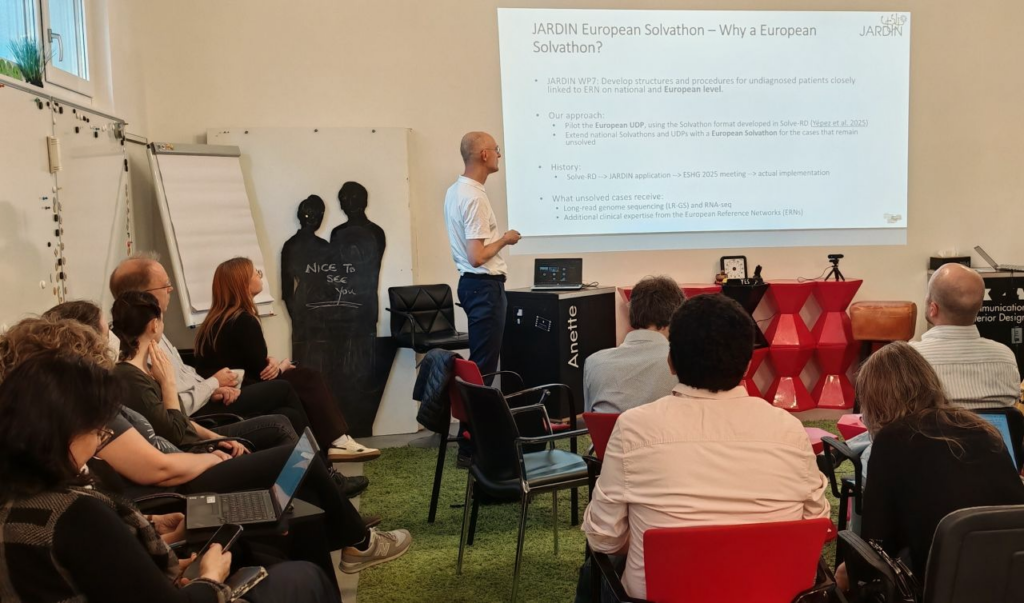
JARDIN European Solvathon event


