 CONTACT





Sweden adopts its first national strategy for rare health conditions
June 29th, 2026
-

- National Strategy
- Rare Diseases
- Sweden
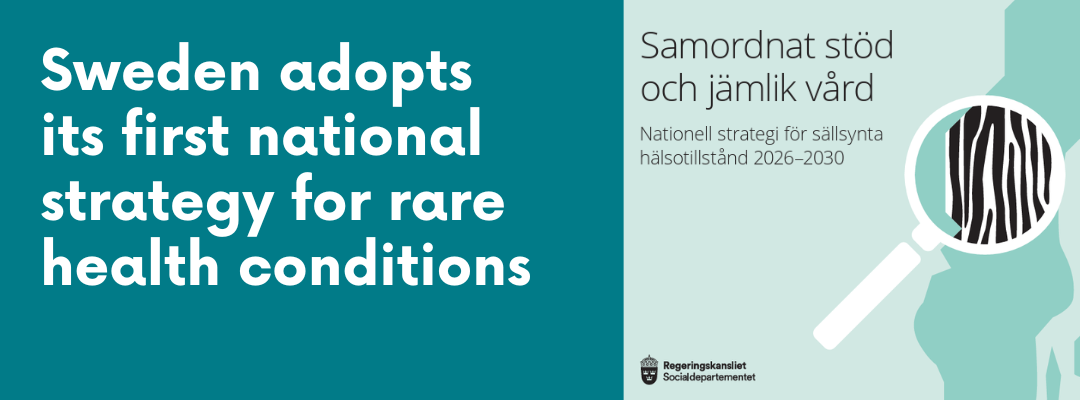
The strategy, Coordinated support and equitable care – National strategy for rare health conditions 2026–2030, marks an important step towards more coordinated, equitable and knowledge-based care for people living with rare diseases in Sweden.
People with rare health conditions often have complex and lifelong care needs, while knowledge, coordination and access to specialised care may vary. The new strategy aims to bring together national authorities, regions, universities, healthcare professionals, and patient organisations around shared goals.
The strategy focuses on early diagnosis, equitable access to care and medicines, better support throughout the care pathway, increased knowledge among healthcare professionals, stronger patient involvement, and improved use of health data for care, research, innovation and medicines development.
The National Board of Health and Welfare has been assigned to coordinate, support and follow up the implementation of the strategy. Several additional initiatives are also being funded, including support to university hospitals, the national newborn screening programme, the regional Centres for Rare Diseases, Ågrenska, the Swedish National Association for Rare Diseases and EUPATI Sweden.
The strategy is closely linked to other national developments in precision health, clinical trials, cancer care, medicines policy and health data. Together, these initiatives can strengthen Sweden’s contribution to European collaboration, including the European Reference Networks and the broader objectives of JARDIN.
This is a welcome and long-awaited development for patients, families, professionals, and all actors working to improve care and coordination for rare diseases across Europe.
Read more:
- https://www.regeringen.se/pressmeddelanden/2026/06/ny-strategi-ska-starka-varden-vid-sallsynta-halsotillstand
- https://www.regeringen.se/informationsmaterial/2026/06/samordnat-stod-och-jamlik-vard—nationell-strategi-for-sallsynta-halsotillstand-20262030
[1]: https://www.regeringen.se/pressmeddelanden/2026/06/ny-strategi-ska-starka-varden-vid-sallsynta-halsotillstand/ «Ny strategi ska stärka vården vid sällsynta hälsotillstånd – Regeringen.se»


