 CONTACT




- ERNs
- Patient Stories
- RITA LAILA'S STORY

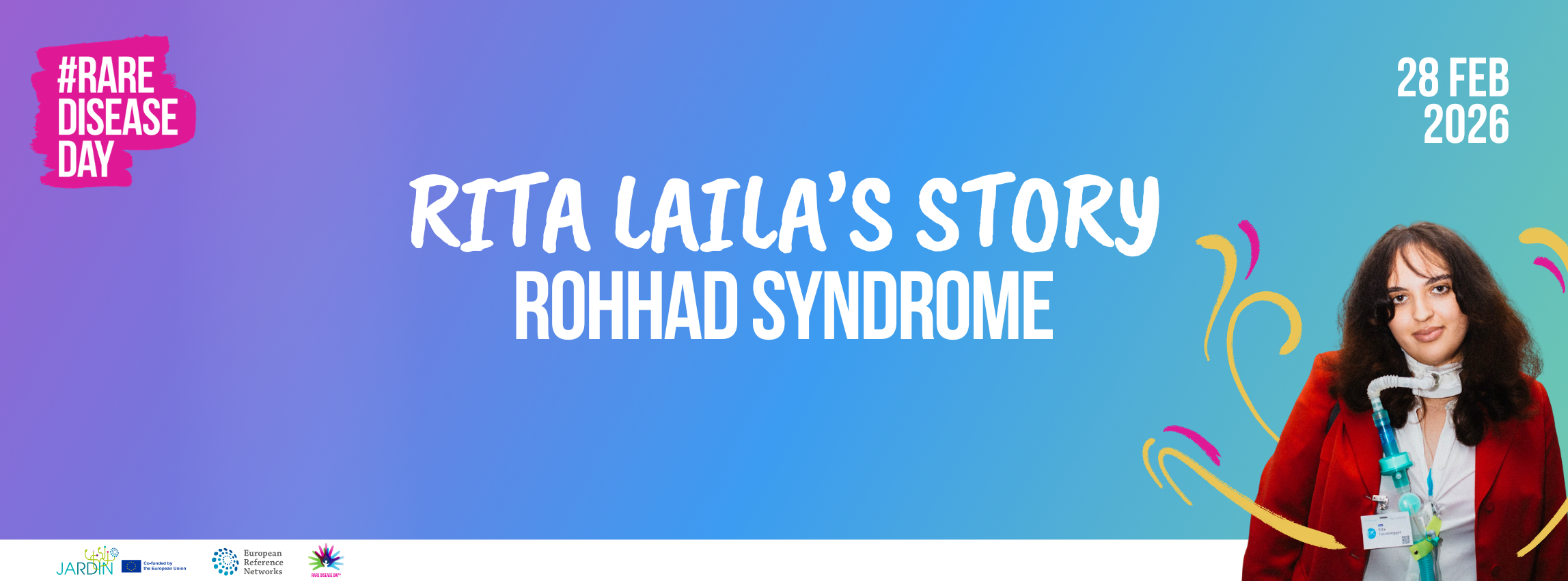
“I Had to Diagnose Myself”: Living with ROHHAD and why ERNs matter more than people think
There is a moment in every rare disease journey when silence becomes unbearable.
For me, that moment came after years of being dismissed, ignored, and told that my symptoms were “psychological.” I was a teenager fighting for my life, dying — and the system that was supposed to protect me decided I was “dramatic” instead.
My name is Rita Laila. I’m 24 years old. And I work as a Founder & Activist in the Health sector.
And besides winning the lottery in multiple rare genetic diseases, I also live with a terminal disease called ROHHAD syndrome. Super rare. Super life-threatening. Super misunderstood.
ROHHAD affects the brain and immune system — especially the hypothalamus and autonomic nervous system, which means all the things your body is supposed to regulate automatically can suddenly decide not to cooperate anymore. Breathing. Heart rate.
Temperature. Hormones. Seizures. Metabolism. You name it. We have it.
As a teenager, I started having serious breathing problems, especially when tired or asleep. I woke up exhausted, confused, and increasingly unwell. I went to hospitals again and again
— and again. The answer was always the same: stress, anxiety, mental health, female and
„too young to be that sick“.
Even when I stopped breathing and needed my first of many resuscitation, at 16, the explanation somehow remained… psychological. And must be a “broken-heart syndrome” (google it it’s fascinating)
I was repeatedly told my body was lying — and that I was lying. Until I was dying
So I did what many rare disease patients eventually do: I started researching myself.
At 17, I developed my own way to test the brain’s central CO₂ receptors. Because my lungs looked perfectly fine on CT scans. Turns out: central hypoventilation. Wich I already, told doctors when I was 14.
At 18 — after a three-week coma due to respiratory failure — I contacted a specialized hypoventilation center in Germany, packed my thing and went there on my own. Finally, someone listened. The hypoventilation was acknowledged and properly diagnosed, with every test there is.
But still, no one knew why.
More time was passing by and my condition was progressing. I developed severe autonomic instability and endocrine dysfunction. I became increasingly dependent on medical support. Like many rare disease patients in the beginning, I was now diagnosed with some sort of physiology, but still not understood which rare disease was causing it.
When I returned to my home country — where there was no hypoventilation expertise and noone who wanted to manage my case. I neede to keep case managing myself, like I always did, since being 13. Unfortunately, it didn’t work for long. At 20 years I entered an active dying stage after being resuscitated multiple times, sent home dying in the beginning of
multi-organ failure, acutely admitted again, and eventually placed, after falling (again) into a CO2 coma, on a life-support: a tracheostomy and pressure-controlled invasive ventilation. Which was decided for me.
I somehow managed, before passing out into a CO2 coma, and being operated for a trach and vent, to tell them, that the syndrome that mostly would make sense is ROHHAD. They then called with the specialists in Germany, and confirmed together the diagnosis, while I was still sleeping (or as doctors now like to call it: fighting for my life)
I’m still on the vent and trach today. I am still not cured.
But I am so happy, to have survived everything, and been shaped to the human I am today – all by a rare diseases that “should have” taken my life 4 years ago .
Getting a diagnosis didn’t cure me — but it kept me alive.
ROHHAD is extremely rare and often diagnosed far too late. Many children die suddenly before anyone understands what’s happening. But also ROHHAD kills, mostly right after getting the diagnosis.
Others with a rare disease spend years being misdiagnosed, dismissed, or medically gaslit. My “rare” story is not rare — and that’s exactly the problem.
Living with ROHHAD means living with constant uncertainty. Things most people never think about — breathing, heart rate, temperature — can become life-threatening without warning. So you start living, like everything is fine. Even when you are the one having the emergency. Being Delulu, is the key to survival. And you learn that with a rare disease, you need to fake yourself into a „normal“. When your reality summs up, being constantly admitted to ICU, transferred back home by ambulance, asking to get delivered at your favourite Cafe for your Coffee date, instead of getting home back to your Home ICU, is a normal. And it also makes living with non-related Health problems “young adult life”, quite easy to handle. Staying Delulu, is the key to life!
Today, I live with ROHHAD as an adult, mostly traveling through Europe while dependent on invasive ventilation. I’m also a healthcare initiator and advocate — keeping Me busy with 16h of work everyday, and hoping to make a change through the trauma I went through.
Where European Reference Networks (ERNs) matter…
ERNs connect what is otherwise isolated: countries, disciplines, clinicians who might only ever see one ROHHAD patient in their entire career. They allow knowledge to travel faster than rare diseases do. They create shared responsibility instead of lonely decision-making.
ERNs turn rare diseases from isolated cases into collective knowledge.
Through ERNs, rare patients are taken seriously, clinicians are supported, and care becomes safer and more coordinated. For me, ERNs mean recognition — that my disease is real, that my experience matters, and that future patients might not have to diagnose themselves to survive. And time is not lpost.
Rare Disease Day is not just about awareness. It’s about accountability.
About building systems that catch patients earlier, support doctors better, and stop dismissing people just because their disease is rare.
I’m still terminally ill. I still depend on machines. But I have learned soo much.
I am no longer invisible — and I refuse to let others be.
No rare or undiagnosed journey should ever be walked alone. And it should never be gaslit.
The ERN Overarching Youth Panel brings together young people with rare diseases from across Europe to make sure their voices are heard within the European Reference Networks. The panel allows young patients to share their experiences, especially around the move from children’s to adult healthcare, and to help improve how care is organised. Youth Panel members work together, take part in meetings and workshops, and contribute directly to ERN projects and recommendations. The goal is to ensure that healthcare for young people in Europe with rare diseases is more supportive, inclusive, and shaped by those with lived experience.
Young adult patients can join by contacting ern.rareliver@uke.de


