 CONTACT




- ERNs
- Patient Stories
- VERONICA’S STORY
VERONICA’S STORY
- February 24th, 2026
- ERN RITA. ERN on immunodeficiency, autoinflammatory and autoimmune diseases
-
 Spain
Spain
- Share
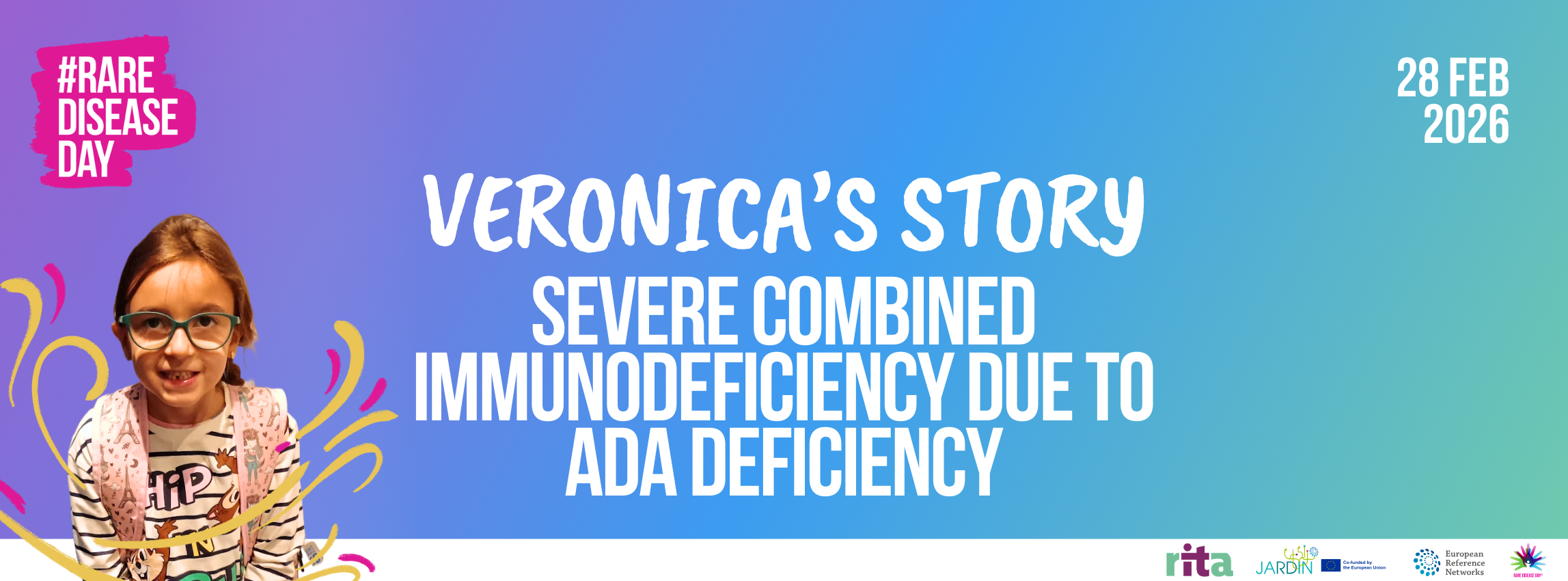
My daughter Veronica is 8 years old and is now a happy girl with a practically normal life, but her beginnings were not like that.
At three months old, one day I noticed that she was not well, but I did not know what was happening. It may have been a mother’s intuition. We took her to Emergency Department, and that is where her journey began.
For a month, she was admitted without a diagnosis and, seeing that she was not improving, we were referred to another hospital. When we arrived by ambulance at the new hospital, they admitted her to the oncology ICU, and at that moment our world fell apart. However, the director told us that, based on Veronica’s results, what she had was not cancer, which was her speciality, but she wanted to carry out further tests to understand what was happening to our little girl. The next day she told us that she had spoken with the doctors at La Paz Hospital in Madrid and that we were being referred there, because they believed they would know how to treat our little girl.
After a few days of tests, the doctors sat down with us and told us that Veronica had a rare disease called severe combined immunodeficiency due to ADA deficiency. They explained that her body does not produce immune defenses, and that is why she is unprotected against any illness. They told us that she was a “bubble girl”. At that moment I remembered the film I had seen a few years earlier, called The Boy in the Plastic Bubble, and I began to recall that it was about a boy who lives isolated in a bubble inside his room and has no contact with the outside world. And you think, “Is that what my daughter is going to live?” After the frustration, the pain and the fear, hope came when the doctors told us that Vero needed a bone marrow transplant to recover and that they had started the search for a donor.
The search for a donor was long. My daughter was five months old and we were waiting to find someone to save her life.
When she was almost nine months old, one day we were told that a compatible donor had been found, but for personal reasons, they could not donate immediately. In that same moment, you go from joy to sadness, through the uncertainty of what will happen, and the anger that someone has other things to do when your daughter needs it. How selfish human beings can be. Even when someone is willing to donate, we want their life to stop for us. Now I realise it.
During the wait, the doctors told us about a gene therapy they had found in London for Vero’s disease, and asked whether we wanted to participate. Suddenly, you find yourself thinking about what would be best for your daughter, whether to keep waiting or to venture to a different, unfamiliar country, with a language unknown to us and without knowing whether that would be good for her or not. It is true that the doctors let us ask them everything, and although they did not tell us what they would do themselves, I asked them about the pros and cons of each option. After thinking about it carefully, we went there.
The process until we reached the crucial moment of gene therapy was long, with many emotional ups and downs, and with tests that did not go as well as we had hoped. Our little girl went through difficult moments, and so did we, as we were aware of everything that was happening. But at eighteen months old, the day came to give Vero the opportunity to be born again. The opportunity to begin the path to recovery.
Today, she is happy and lives an almost normal life, apart from medical visits in Spain and London. Even for her, her trips to London are enjoyable.
People who know her always say how brave she is. But I say that she is a fighter, with a lot of character, and that she lights up the lives of those around her.
As she grows up, she struggles to understand what she went through, and often does not know how to manage it and finds it difficult.
I believe that research is fundamental, and not feeling alone is also important for her recovery. Hopefully there will be more people who help in the treatment of rare diseases, which, although rare, do exist.
Mi hija Verónica, tiene 8 años y ahora es una niña feliz y con una vida prácticamente normal, pero sus comienzos no fueron así.
A los 3 meses de nacer, un día noté que no estaba bien, pero no sabía que la pasaba, puede ser intuición de madre. La llevamos a urgencias, y ahí empezó todo su camino.
Durante un mes, estuvo ingresada, sin tener un diagnóstico y viendo que no mejoraba nos derivaron a otro hospital. Al llegar en la ambulancia al nuevo hospital, nos meten en la UCI de oncología, y ahí el mundo se nos vino encima…pero la directora nos comentó, que con los resultados que la habían pasado de Verónica, lo que tenía no era cáncer, que era su especialidad, pero que quería hacer otras pruebas, para poder ver que la sucedía a nuestra pequeña. Al día siguiente nos comenta que ha hablado con los médicos del Hospital de La Paz de Madrid y que nos derivan allí, porque creen que allí van a saber tratar a nuestra pequeña.
Tras unos días de pruebas, los médicos se sientan con nosotros, y nos comentan que Verónica tiene una enfermedad rara, denominada Inmunodeficiencia combinada grave por déficit de ADA. Lo que nos explican, es que su cuerpo no genera defensas, y por eso su cuerpo está desprotegido ante cualquier enfermedad. Nos dicen que es una “niña burbuja”. En ese momento recuerdo la peli que vi hace unos años, que se llamaba así el “niño burbuja” y empiezo a recordar que es un niño que vive aislado en una burbuja dentro de su habitación y que no tiene contacto con el exterior…y piensas… “¿eso es lo que va a vivir mi hija?”. Tras la frustración, el dolor y el miedo, viene la esperanza, cuando los médicos te cuentan, que Vero necesita un trasplante de médula ósea para recuperarse…y que han empezado la búsqueda de donante.
La búsqueda del donante fue larga, mi hija tenía 5 meses y estábamos a la espera de encontrar a alguien que la salvara la vida.
Con casi 9 meses, un día nos dicen que han encontrado un donante compatible, pero que por motivos personales, no podía donar de manera inmediata…así que en un mismo momento, pasas de la alegría a la tristeza, pasando por la incertidumbre de qué va a pasar, y el cabreo de que alguien tenga otras cosas que hacer, cuando tu hija lo necesita …Que egoísta es el ser humano, encima que alguien dona, queremos que su vida se pare por nosotros…ahora me doy cuenta de ello.
Durante la espera…los médicos nos hablan de una terapia génica que han encontrado en Londres, sobre la enfermedad de Vero, y que si queremos participar. De repente, te encuentras pensando qué sería lo mejor para tu hija, si seguir esperando o si aventurarnos a un país diferente, desconocido, con una lengua desconocida para nosotros y sin saber si eso sería bueno o no para ella. Es cierto que los médicos nos dejaron preguntarles todo, y aunque no te dicen qué harían ellos, yo les preguntaba pros y contras de una cosa y de otra…y después de pensarlo mucho, nos fuimos para allá.
El proceso hasta que llegas al momento crucial de la terapia génica, fue largo, con muchos vaivenes emocionales, y con pruebas que no salieron tan bien como pensábamos. Nuestra pequeña vivió momentos difíciles, y nosotros también, ya que éramos conscientes de todo lo que estaba pasando …pero con 1 año y medio, llegó el día de dar a Vero la oportunidad de volver a nacer. La oportunidad de comenzar el camino de la recuperación.
Hoy en día, ella es feliz, hace vida casi normal, si no fuera por las visitas médicas en España y en Londres. Pero incluso para ella, sus viajes a Londres, son de disfrute.
La gente que la conoce, siempre dicen lo valiente que es. Pero yo digo que es una luchadora, con mucho carácter, pero que ilumina la vida de los que estamos a su alrededor.
A medida que está creciendo, le cuesta entender lo que vivió, y muchas veces no sabe cómo gestionarlo y lo pasa mal.
Creo que la investigación es fundamental, y el no sentirse solos también es importante para su recuperación. Ojalá haya más personas que ayuden en el tratamiento de las enfermedades raras, que, aunque son raras, existen.


