CONTACT




- ERNs
- Patient Stories
- ANDREA'S STORY

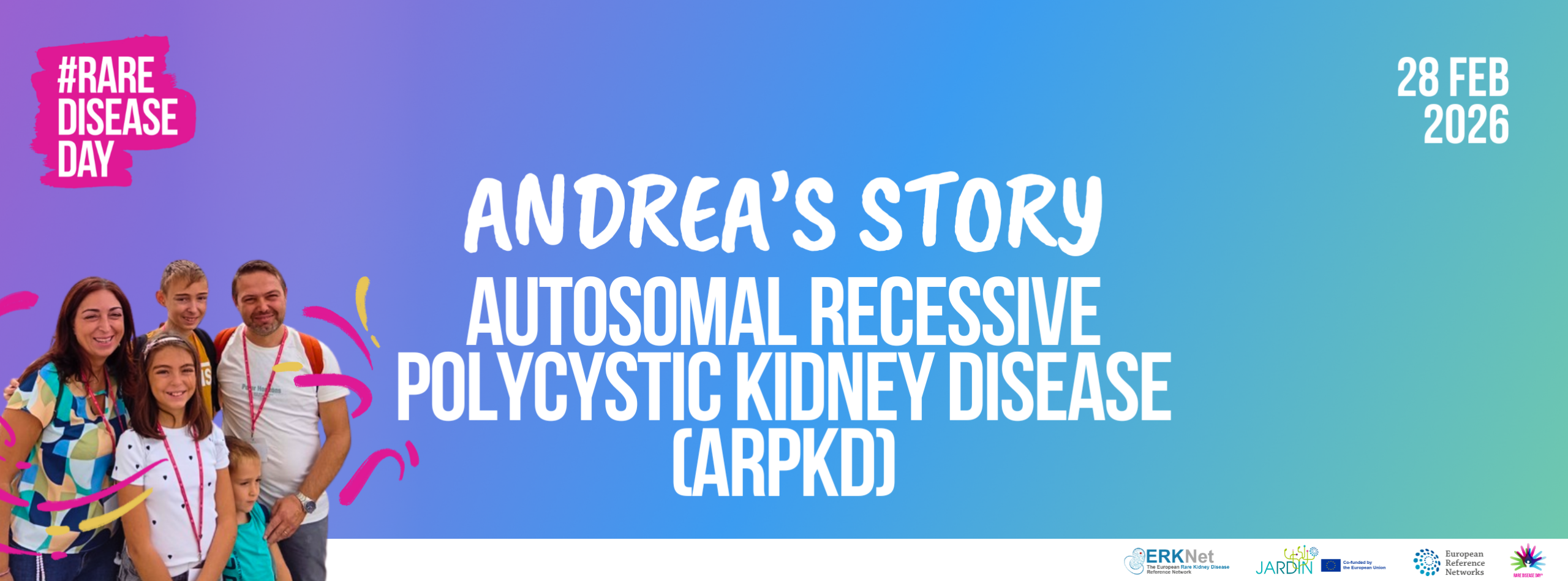
Hi, my name is Andrea. I am 43 years old and the father of three wonderful children: Giuseppe (15), Francesca (10) and Alessandro (5). Two of them, Giuseppe and Alessandro, live with a rare disease: Autosomal Recessive Polycystic Kidney Disease (ARPKD). Being a father in these circumstances means learning very early that life no longer follows the “normal” rhythm of most families. Every decision becomes intertwined with appointments, treatments, hospital stays and waiting times, and the future is measured in small but vital goals.
ARPKD is a rare genetic disease that can already present during pregnancy, when both parents are healthy carriers and pass the altered gene to the child. It can have a very aggressive course: it compromises kidney structure and function at an early stage, leading to the formation of a very large number of cysts, and in some cases it also affects the liver. When we first discovered this, our world collapsed.
I remember the first pregnancy perfectly. We were unbelievably happy: on our way back home after the scan, I was so overwhelmed with excitement that I drove around the same roundabout three times without even realising it. Then, in the seventh month, joy turned into fear — the amniotic fluid suddenly decreased. Today I know that this was one of the first warning signs: the disease was already taking hold even before our baby was born.
Within a short time, we went from appointments filled with plans for the future to increasingly complex consultations, until we met a geneticist who even suggested a therapeutic termination of pregnancy. It is a kind of pain that is hard to describe: you feel powerless and unprepared, as if your family has entered a parallel reality. When a rare diagnosis arrives, there is no “manual”: you learn as you go, often while you are afraid.
With Alessandro, the diagnosis also came during pregnancy. It was another devastating blow, but at least we already knew what certain words meant — words we had never even heard before. As a couple, we chose to continue both pregnancies, but guilt is not something that disappears easily. Guilt is a silent wound that many parents carry, even when you know it is not your fault.
The disease has had a huge impact on our lives: on work, on everyday routines, on our family balance. At times, it feels as if the whole household revolves around the hospital. And the exhaustion is not only physical — it is mental, emotional, constant. When your children live with a rare disease, you stop planning too far ahead: you learn to live one day at a time.
The most critical moment for us was Giuseppe’s liver transplant, when he was 9 years old. We spent long periods at Bambino Gesù Children’s Hospital in Rome — weeks, months — with the feeling that life was on hold. My wife and I had to be there for essential decisions, while at the same time our daughter Francesca, who was only 4 years old, was far away from us. To make sure she did not feel abandoned, I often travelled back late in the evening from Rome to Naples just to see her for a few hours, and then left again at dawn.
It was precisely during that journey that we truly understood what it means to be cared for within a specialised network. Bambino Gesù is part of ERKNet, the European Reference Network (ERN) dedicated to rare kidney diseases. This is not just a technical detail — it made a real difference for our son and for us as parents. Knowing that your child is treated in an ERN centre connected to ERKNet means access to highly specialised expertise in rare paediatric conditions and care pathways shared at European level.
But the greatest impact was not only clinical. We met doctors and nurses with outstanding training in rare paediatric diseases and, above all, with the ability to bring calm and reassurance to parents through the way they communicated with us. They explained the progression of the disease step by step, taught us how to recognise warning signs of deterioration, and involved us in their assessments, so that we could be prepared for the difficult phases ahead. Expertise treats — but humanity saves: they gave us trust, not only therapy.
That sense of calm, built over time, was crucial at the moment of transplantation: we did not experience it only as a time of fear, but as an opportunity for rebirth. The transplant was not the end — it was the beginning of a better life for our son. It gave Giuseppe a new chance: more energy, more stability, and a wider future, allowing him to live childhood and adolescence with hope.
ARPKD remains a complex and progressive condition: it often leads to transplantation, although there is no predictable timeline. Sometimes it progresses slowly for years, and sometimes it accelerates suddenly. It is a fragile balance. Uncertainty is a constant background noise — it never truly goes away.
Today, I continue to live between worry and hope. But the real strength lies in my children: they are the ones who face therapies, medications and continuous monitoring. I may collapse for a moment — they cannot. And so I find the strength.
Along this journey, meeting AIRP and Luisa was also fundamental. Through the association, I connected with other parents in the same situation and built a support network. We also help families receiving the diagnosis for the first time, because no one should face a rare disease alone. I try to face each day with clarity and positivity, keeping a smile even when it is difficult. Because, despite everything, our children teach us something extraordinary: you can be strong even in fragility. Our children are special — and they deserve a future, care, and hope.