 CONTACT





- ERNs
- Patient Stories
- GEORGINA'S STORY
GEORGINA’S STORY
- February 12th, 2026
- ERN GENTURIS. ERN on genetic tumour risk syndromes
-
 Germany
- Share
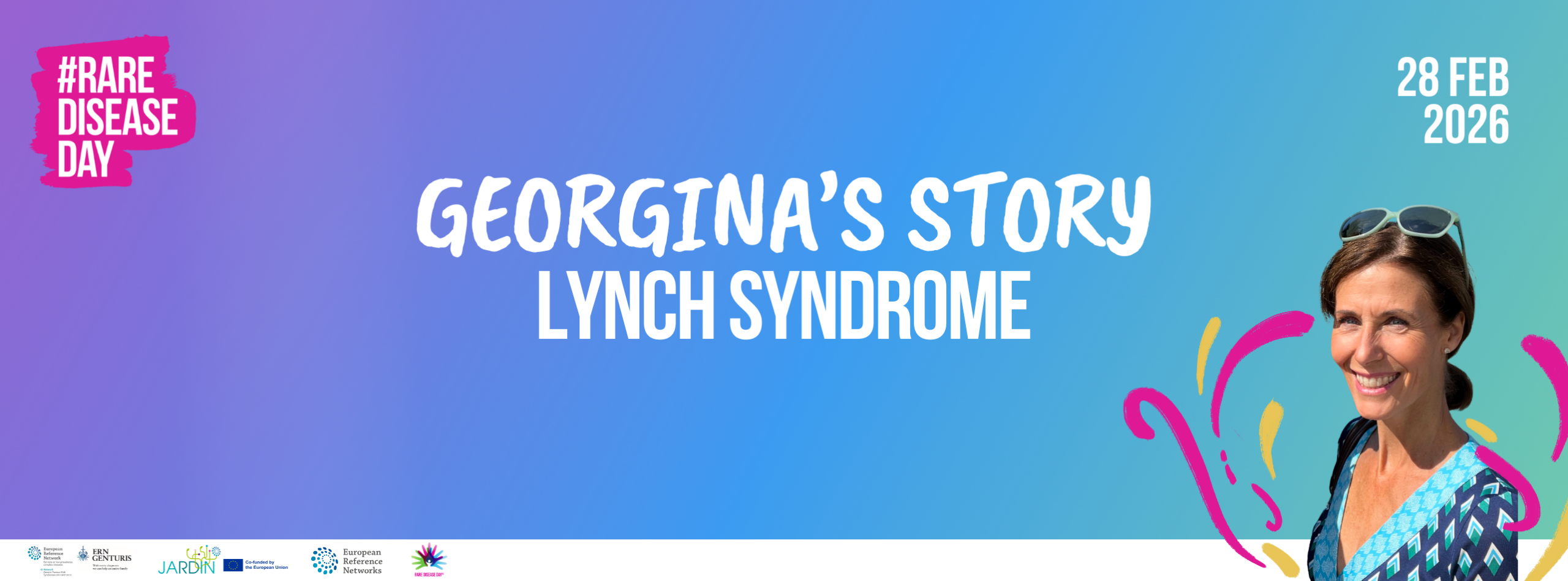
Living with Lynch Syndrome — A Journey of Resilience and Advocacy
I am originally from Toronto, Canada, and since 2002, Germany has been my home, where I live with my husband and our two sons. An active outdoor lifestyle and a plant-based diet are central to my wellbeing and have helped me remain balanced throughout my cancer journey.
My connection with genetic tumour risk syndromes runs deep — cancer has been an enduring part of my family’s story for generations. My great-grandmother passed away from breast cancer at 43, my grandmother faced colon cancer at 44, and my mother was also diagnosed with colon cancer at the young age of 40. Her three sisters also received their own various cancer diagnoses. I grew up fully aware that my family’s medical history was unique — and serious.
In the late 1980s, an article in the newspaper about hereditary cancer changed everything. It prompted my mother to call our family doctor, who arranged an appointment with a geneticist, leading to our family’s participation in the Ontario Familial Colorectal Cancer Registry (OFCCR). My family members were among the first patients in the late 1990s to undergo genetic testing for Lynch syndrome, confirming a pathogenic MSH2 gene variant. This discovery brought both clarity and hope and laid the foundation for the genetic understanding that benefits so many patients today.
When I was tested in 2002, I too received confirmation of the MSH2 variant. My first direct confrontation with this genetic legacy occurred in 2009, when a benign uterine polyp was removed. In May 2018, just before my 47th birthday, I faced my most serious challenge: an aggressive, MSI‑high ovarian cancer. Within just 13 months of my last gynaecological check-up, a small water cyst had grown into a grapefruit-sized tumour on my left ovary. The diagnosis of high-grade ovarian cancer, together with severe endometriosis, led to a complete hysterectomy and peritoneal removal — an operation that triggered an immediate and life-altering surgical menopause.
Almost four years later, after months of severe abdominal pain, I was diagnosed with colon cancer. In December 2021 a right-sided hemicolectomy was performed just two days before Christmas. Nine days later, January 1st, 2022, I was rushed back to the hospital for emergency surgery due to an anastomotic leak that caused sepsis — a potentially life-threatening complication. Cancer teaches you that healing is not linear; it is a process of endurance, trust, and adaptation. I am deeply grateful for the medical staff and their care and interventions, including a blood transfusion, that saved my life.
Pathology results confirmed another new primary MSI‑high tumour, making me an eligible candidate for an immunotherapy study. I was accepted into the ANTONIO study, receiving Atezolizumab every two weeks for a year. Being part of this clinical study gave me renewed hope and access to cutting-edge treatment. It also strengthened my desire to support scientific research and innovation.
Today, as an ePAG (European Patient Advocacy Group) representative within ERN GENTURIS, I see every day how structured collaboration can transform patient care. The network unites 51 healthcare providers across 23 countries, connecting experts and patients to share knowledge, standardise care, and advance precision medicine for those living with genetic tumour risk syndromes. For patients with Lynch syndrome, ERN GENTURIS is more than a network — it is a community built on connection, compassion, and science.
To the international medical community, my message is twofold: thank you — and please continue. Your dedication to research, genetics, and prevention continues to save and transform lives. Through collaboration, compassion, and science, we can redefine what it means to live with Lynch syndrome and other hereditary cancer syndromes.
Living with a complex genetic condition is not only a medical challenge — it is also a journey of personal transformation. It demands courage, patience, and advocacy. As both a patient and advocate, I remain hopeful that the future of medicine will be guided by connection, precision, and empathy.
As we say at the ERN GENTURIS – “With every diagnosis we can help an entire family.”


